

Execution scales through systems. Alignment scales through leadership.
The Illusion of Alignment
Most organisations don’t struggle because people refuse to work together.
They struggle because hundreds of intelligent people make sensible decisions that slowly move in different directions.
It rarely begins with conflict.
It begins with agreement.
I’ve sat in that room. A leadership team gathers to discuss an opportunity.
Customer signals are reviewed.
The problem is debated from multiple perspectives.
Trade-offs are explored.
Priorities are challenged.
A direction is chosen.
The room leaves with genuine confidence.
There is clarity.
Engineering understands what needs to be built.
Design understands the experience they want to create.
Marketing understands the story they intend to tell.
Sales understands the opportunity.
Support prepares for the questions customers are likely to ask.
For a brief moment, the organisation shares a common picture of the future.
Then reality begins its work.
New information appears.
Technical constraints emerge.
Deadlines move.
Budgets tighten.
Customer behaviour changes.
Competing priorities arrive.
Every team responds responsibly to the reality immediately in front of them.
Engineering removes complexity to reduce implementation risk.
Design simplifies interactions to improve usability.
Marketing adjusts messaging to fit a changing launch plan.
Operations optimises for scale.
Finance asks for greater efficiency.
Support identifies issues no one anticipated during planning.
None of these decisions are irrational.
None of them are attempts to ignore the original strategy.
Each one makes sense when viewed in isolation.
Yet months later something feels different.
The product ships.
The roadmap is complete.
The programme reports green.
But the customer experience is weaker than everyone expected.
Leadership begins searching for execution problems.
The organisation starts talking about delivery quality, governance, communication, accountability, or ownership.
Sometimes those are genuine issues.
But often they are symptoms rather than causes.
The organisation never stopped executing.
It gradually stopped moving in exactly the same direction.
That is the distinction this article explores.
Preserving alignment while hundreds of independent decisions are made is.
Why Alignment Breaks Down
Alignment is often treated as a communication problem.
The proposed solutions are familiar.
Communicate more.
Hold more meetings.
Improve stakeholder management.
Document decisions more clearly.
These practices matter.
But they don’t explain why organisations with exceptional communication still lose alignment.
The reason is deeper.
Alignment isn’t lost because people stop talking.
It is lost because people begin responding to different realities.
Engineering sees technical constraints.
Design sees usability.
Sales sees revenue opportunities.
Finance sees cost.
Legal sees risk.
Operations sees scalability.
Support sees recurring customer friction.
Product tries to balance all of them.
Every perspective also changes what appears to be the right decision.
Over time the organisation isn’t guided by one reality.
It is guided by many local realities.
Alignment slowly fragments—not because people disagree about the destination, but because they optimise for different paths toward it.
Complexity doesn’t simply increase the amount of work.
It multiplies the number of realities that leadership must continuously reconcile.
Agreement Is Not Alignment
One of the most common misconceptions inside organisations is treating agreement and alignment as though they mean the same thing.
They don’t.
Agreement answers:
Do we support this decision?
Compliance answers:
Will we follow the agreed process?
Alignment answers something much harder.
As reality changes, will our independent decisions continue moving toward the same intent?
An organisation can leave Monday’s leadership meeting completely aligned.
By Friday every team may still believe they are supporting that decision while collectively creating a different outcome.
That is why alignment cannot be measured by meeting outcomes.
It must be observed through the consistency of decisions made long after the meeting has ended.
PM Pathfinder Framework™
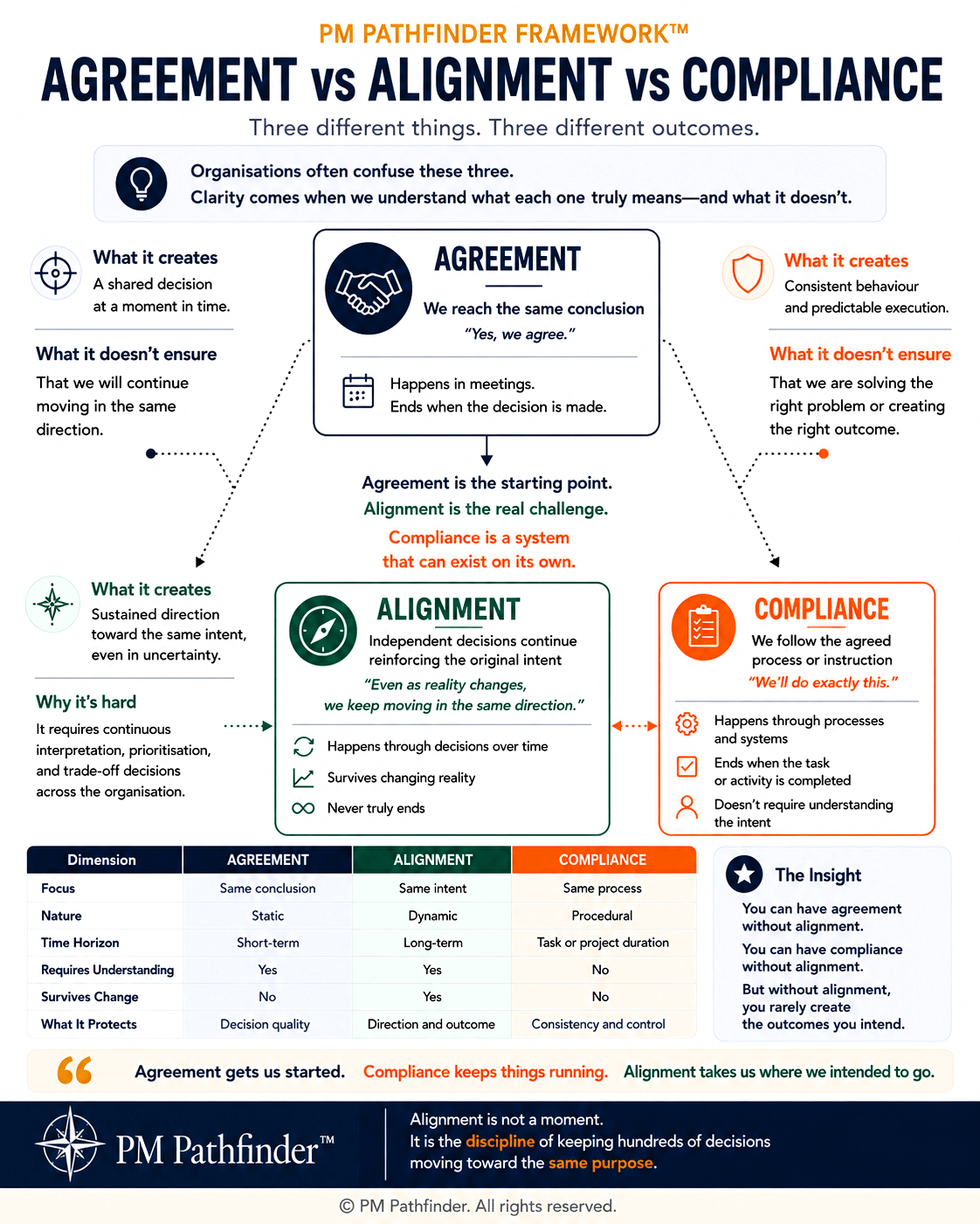
Organisations often use these three words interchangeably.
In practice, they describe three very different organisational behaviours.
Understanding the distinction changes how we interpret leadership, execution, and organisational performance.
Compliance is about following the same instruction.
Alignment is about preserving the same intent.
At first glance, the differences seem subtle.
In reality, they determine whether an organisation simply completes work—or consistently creates the outcomes it intended.
Interpretation
The framework reveals why so many organisations appear healthy internally while producing disappointing outcomes externally.
Agreement creates a shared decision.
People leave the meeting believing they understand the direction.
Compliance creates consistent behaviour.
Teams follow agreed processes, governance, standards, and delivery expectations.
Both are valuable.
Neither is sufficient.
Because organisations rarely succeed simply by making one good decision or faithfully following one process.
They succeed when hundreds of independent decisions continue reinforcing the same intent as reality changes.
That is alignment.
This distinction explains why an organisation can have complete agreement during planning, high compliance throughout delivery, and still fail to achieve the outcome it originally intended.
The meeting was successful.
The governance was followed.
The roadmap was delivered.
Yet somewhere between the original decision and the customer’s experience, the organisation quietly drifted away from its purpose.
The problem wasn’t disagreement.
The problem wasn’t non-compliance.
The problem was that alignment gradually weakened as every team optimised for the reality immediately in front of them.
This is why alignment cannot be treated as a one-time activity.
It isn’t created when a roadmap is approved.
It isn’t guaranteed because everyone understands the plan.
And it isn’t preserved by process alone.
That is what makes it fundamentally different from both agreement and compliance.
And that is precisely why it becomes the hardest leadership challenge as organisations grow.
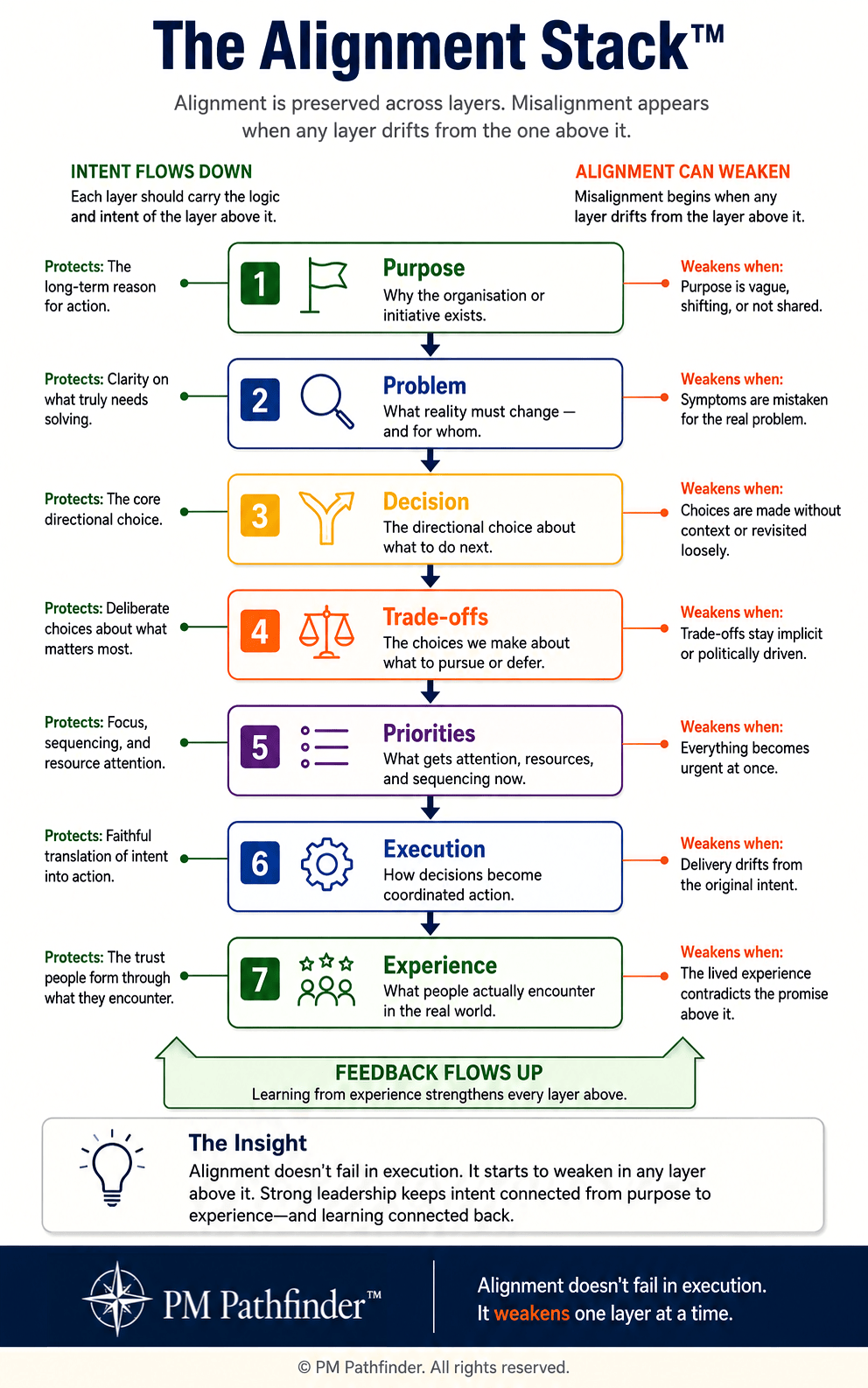
The Alignment Stack™
Execution doesn’t happen in one step.
Neither does alignment.
It passes through layers.
Each layer either preserves intent—or quietly changes it.
Purpose ↓Problem ↓Decision ↓Trade-offs ↓Priorities ↓Execution ↓Experience
Purpose explains why the work matters.
Problem defines what truly needs to change.
Decision chooses the direction.
Trade-offs determine what will intentionally not be pursued.
Priorities translate decisions into daily work.
Execution builds reality.
Experience reveals what customers actually receive.
Alignment weakens whenever one layer begins serving itself instead of supporting the layer above it.
Most organisations don’t lose alignment during execution.
They lose it somewhere inside this stack.
Local Optimisation Creates Global Misalignment
Imagine a product team trying to improve first-time user activation.
The original decision is clear.
Reduce cognitive complexity during onboarding so new customers reach value more quickly.
Every function understands the objective.
Engineering simplifies the implementation to reduce delivery risk.
Design reduces the number of screens.
Marketing updates launch messaging.
Customer Success prepares enablement material.
Sales begins positioning the improvement during customer conversations.
Each team contributes positively.
Then reality changes.
A release deadline forces prioritisation.
Engineering removes one configuration step.
The release stays on schedule.
Everyone celebrates.
But customer behaviour hardly changes.
Support continues receiving the same questions.
Activation barely improves.
The organisation delivered exactly what was prioritised.
It did not deliver what the original decision intended.
Nobody failed.
Nobody ignored the strategy.
Alignment quietly drifted through a series of individually sensible choices — one layer down from where the leadership team thought they’d locked it in.
The Decision was sound.
Priorities had quietly stopped serving it.
I’ve made this call myself — approved a “small” scope cut under deadline pressure that felt purely operational at the time, only to trace a weak launch back to that exact decision months later.
It rarely looks like a mistake in the room.
It only looks like one in the data.
That is why alignment problems are often invisible until outcomes arrive.
Alignment Is a Leadership Discipline
As organisations grow, execution becomes increasingly systematic.
Processes improve.
Automation increases.
Delivery becomes more predictable.
Alignment moves in the opposite direction.
Every additional team introduces another interpretation.
Another priority.
Another success metric.
Another local optimisation.
Leadership therefore becomes less about directing work.
It becomes more about preserving shared intent.
The question leaders should ask is not:
Are teams aligned?
A better question is:
Where is alignment beginning to weaken?
That shift changes everything.
It moves leadership away from governance and toward continuous diagnosis.
Five Disciplines of Alignment
Strong organisations rarely preserve alignment accidentally.
They develop deliberate habits.
1. Keep decisions visible.
Don’t allow teams to inherit tasks without understanding the decision behind them.
2. Preserve the original problem.
Requirements evolve.
The problem should remain visible.
3. Revisit trade-offs frequently.
Yesterday’s compromise may no longer be today’s best decision.
4. Measure outcomes—not activity.
Completed work doesn’t guarantee meaningful progress.
Customers determine whether alignment survived.
5. Treat new evidence as a leadership input.
Reality isn’t an interruption.
It is feedback.
They improve them.
Alignment Is Never Finished
Many organisations think alignment is something they achieve.
A workshop.
A planning session.
A quarterly roadmap.
A strategy off-site.
It isn’t.
Alignment behaves much more like trust.
You never earn it once.
You preserve it continuously.
Every meeting strengthens it—or weakens it.
Every trade-off reinforces it—or dilutes it.
Every priority either keeps the organisation moving toward the same future—or quietly creates a different one.
Execution doesn’t become difficult because people stop working.
It becomes difficult because the original intent becomes weaker with every handoff.
Final Reflection
Execution is visible.
Alignment is largely invisible.
We celebrate launches.
We celebrate delivery.
We celebrate velocity.
Far less attention is given to whether the organisation is still solving the same problem it originally chose to solve.
Perhaps that is why so many initiatives appear successful internally while producing disappointing outcomes externally.
The work was completed.
The roadmap moved.
The programme finished.
Yet the customer experienced something different from what leadership intended.
That isn’t simply an execution problem.
It is an alignment problem.
And alignment isn’t preserved through better communication alone.
Alignment is preserved through the continuous discipline of reconnecting every decision, every trade-off, and every action to the original intent.
Because organisations rarely lose their direction all at once.
They lose it one reasonable decision at a time.
Continue Exploring This Perspective
The Hidden Cost of Misaligned Decisions Before alignment breaks silently, it accumulates as debt. A closer look at what happens when misaligned decisions compound over time — and what it costs to repay them.
Signal-Led Product Thinking — Execution: Translating Decisions into Reality A decision doesn’t fail in the meeting room. It fails in translation — as it moves through interpretation, prioritisation, and delivery. Two frameworks for closing that gap.
Signal-Led Product Thinking — Decision-Making: Where Most Teams Fail Most flawed outcomes trace back to a flawed decision moment, not a flawed execution moment. A look at where teams actually go wrong, earlier than they think.
If any of this feels familiar — in your product, your team, or your organization — I’m always open to a thoughtful conversation.
Thanks for Reading 🙏
🧭 Every organisation talks about alignment.
Far fewer understand how it is gradually created—or quietly lost.
If this article helped you see alignment differently, I hope it encourages a different kind of leadership conversation inside your own organisation.
Because product leadership is rarely about ensuring everyone moves faster.
Product leadership is ensuring everyone continues moving toward the same purpose, even as reality changes.
Explore all articles at www.thepmpathfinder.com.
Leave a Reply