

Most execution problems do not begin in execution.
They begin much earlier.
A leadership team identifies an opportunity.
Customer signals are reviewed.
The problem is debated.
Trade-offs are discussed.
A direction is chosen.
The roadmap is approved.
The room leaves with a genuine sense of clarity.
Then the decision begins moving through the organisation.
Engineering interprets what must be built.
Design interprets what the experience should become.
Data interprets what success should look like.
Delivery teams translate priorities into plans.
Marketing translates the product into a promise.
Support prepares to explain it to customers.
Regional teams adapt it to local realities.
Nobody intentionally changes the original decision.
Nobody deliberately weakens the strategy.
Yet, months later, what reaches the customer can look remarkably different from what the organisation originally intended.
The feature exists.
The release happened.
The roadmap moved.
The delivery report is green.
But the outcome is weaker than expected.
Customers do not respond as hoped.
The experience feels fragmented.
The team begins debating whether the original decision was wrong.
Sometimes it was.
But often, the decision did not fail.
It was gradually altered on its way into reality.
That is the execution problem this article explores.
Not how to manage sprints.
Not how to run ceremonies.
Not how to move tickets faster.
But how to preserve the intent behind a decision as it travels through interpretation, prioritisation, coordination, delivery, experience, and learning.
Because a good decision has no value until reality begins to reflect the intention behind it.
This piece comes in two parts:
Part One diagnoses where decisions actually get lost inside an organisation — it introduces the Decision Translation Model.
Part Two is the discipline for keeping a decision honest once work is already underway — it introduces the Intent Preservation Loop. Part One stands on its own if you want to stop there and come back later. Part Two builds on it.
Part One: Where Decisions Get Lost
Why Good Decisions Still Fail
Two product teams can begin with almost identical advantages.
Both understand the customer problem.
Both have capable people.
Both work with strong engineering and design teams.
Both have executive support.
Both approve a sensible roadmap.
Yet six months later, one creates meaningful user and business impact while the other produces activity without transformation.
The difference is often described as “execution quality.”
That phrase is correct, but incomplete.
It can hide the real mechanisms underneath.
Execution may weaken because:
- the original problem is compressed into a feature request;
- the rationale disappears while the requirement survives;
- different teams optimise for different interpretations of success;
- deadlines force trade-offs that are never connected back to intent;
- ownership becomes fragmented across handoffs;
- delivery progress is measured more carefully than outcome progress;
- early evidence is ignored because the plan is already in motion;
- nobody checks whether the emerging reality still resembles the original decision.
The organisation remains busy.
People continue doing competent work.
But the work slowly moves away from the reason it began.
This is why execution failure is frequently misunderstood.
It is not always a failure of effort.
It is often a failure of translation.
The Decision–Reality Gap
Every important product decision creates two versions of the future.
The first is the intended reality:
- the user problem we expect to solve;
- the behaviour we hope to change;
- the value we intend to create;
- the experience we want people to encounter;
- the business outcome we believe will follow.
The second is the delivered reality:
- what the organisation actually prioritises;
- what the team is able to build;
- what constraints reshape the solution;
- what customers ultimately experience;
- what outcomes genuinely emerge.
The distance between these two is the Decision–Reality Gap.
The Decision–Reality Gap is the distance between what an organisation intended and what eventually becomes real.
A small gap is normal.
No decision survives reality unchanged.
New information appears.
Technical constraints emerge.
Customer behaviour surprises us.
Regulation, timing, cost, capacity, and dependencies reshape what is possible.
Good execution does not mean preventing all change.
It means ensuring that changes remain conscious, visible, and connected to the original purpose.
The gap becomes dangerous when the decision changes gradually but nobody can explain:
- what changed;
- why it changed;
- who made the trade-off;
- what consequence was accepted;
- whether the outcome is still worth pursuing.
At that point, the organisation may still be executing the plan.
But it is no longer necessarily executing the decision.
Why the Gap Is Difficult to See
The Decision–Reality Gap rarely appears as one dramatic breakdown.
It accumulates through small, reasonable adjustments.
A scope reduction to meet a deadline.
A technical compromise to manage risk.
A missing dependency moved to a later phase.
A simplified onboarding flow that removes important context.
A metric selected because it is easier to track.
An AI workflow optimised for deflection rather than resolution.
A regional variation introduced without reconsidering the core experience.
Each choice may be defensible.
The problem emerges when those choices are evaluated locally but experienced collectively.
Customers do not see separate organisational decisions.
They experience one product.
They do not distinguish between a roadmap trade-off, a platform constraint, a support policy, and an interface decision.
They experience the cumulative result.
This is why execution can look healthy internally while feeling broken externally.
Externally, the total experience may still fail to deliver the intended value.
Execution Is Not the Same as Delivery
Delivery matters.
Without reliable delivery, decisions remain theoretical.
But delivery is only one part of execution.
A team can deliver:
- the approved scope;
- the committed release;
- the expected features;
- the agreed deadline;
and still fail to create the intended outcome.
This happens because delivery asks: Did we build and release what we planned?
Execution asks: Did what we built move reality in the direction the decision intended?
That difference is fundamental.
A feature can ship without being understood.
A workflow can launch without reducing friction.
An AI assistant can respond faster without improving resolution.
A dashboard can go live without helping anyone make a better decision.
A pricing change can increase conversion while weakening trust.
A roadmap can be completed while the original problem remains unsolved.
Shipping proves that work was completed.
It does not prove that intent survived.
Traditional Execution vs Signal-Led Execution
| Traditional view | Signal-led view |
|---|---|
| Execution starts after the decision | Execution starts when the decision is interpreted |
| Delivery is the primary proof of progress | Evidence of changed reality is the primary proof |
| Handoffs transfer work | Handoffs translate intent |
| Roadmaps guide execution | Intent, evidence, and outcomes guide execution |
| Deviation from plan is failure | Unexamined deviation from purpose is failure |
| Success means shipping | Success means creating the intended change |
| Learning happens after launch | Learning happens throughout execution |
| Signals validate the finished product | Signals continuously shape the work |
The signal-led view does not reject planning, roadmaps, or delivery discipline.
It places them inside a larger system.
Plans organise action.
Intent helps teams interpret change.
Judgment determines when to stay the course and when to adapt.
The PM Pathfinder Lens™
The PM Pathfinder™ Model frames product thinking as a continuous system:
Signal → Insight → Decision → Execution → Perception → New Signals
Execution is the point where an internal choice becomes an external reality.
Before execution, the decision exists as intent.
After execution, it exists as experience.
That makes execution more than operational follow-through.
It is the translation layer between:
- what the organisation understood;
- what it chose;
- what teams built;
- what users experienced;
- and what the system learned next.
If that translation is weak, even a high-quality decision can produce a low-quality reality.
If the translation is strong, the organisation can preserve purpose while still adapting intelligently to new information.
That translation happens in two distinct places — and this article covers both.
One is structural: where in the organisation a decision typically gets bent.
The other is a discipline: how a team keeps steering once the work is already underway. They answer different questions, and neither replaces the other.
The Decision Translation Model™

The Decision Translation Model explains how a decision moves from organisational intent into real-world consequences.
It is a diagnostic tool — use it to ask where a decision lost clarity, not what to do about it day to day. That second question belongs to the Intent Preservation Loop, further down.
The model deliberately places several stages between Decision and Execution.
That is where much of the article’s core argument lives.
Organisations often behave as though a decision moves directly into action.
In reality, every decision passes through multiple layers of translation.
Each layer can preserve the intent.
Each layer can improve it.
And each layer can distort it.
1. Decision
A decision defines a chosen direction.
But a useful decision needs more than an answer.
It should make clear:
- the problem being addressed;
- the evidence supporting the choice;
- the intended user and business outcome;
- the trade-offs being accepted;
- the assumptions that remain uncertain;
- the conditions that would justify reconsideration.
A weak decision says: Build this capability.
A stronger decision says: We believe this capability will reduce a specific user friction, improve a particular behaviour, and create a defined business effect. We are accepting these costs and will reconsider if these signals appear.
The second version is easier to execute because it carries intent, not just instruction.
2. Interpretation
This is where translation begins.
Different teams naturally interpret the same decision through different professional lenses.
Leadership may hear growth.
Engineering may hear scalability and system risk.
Design may hear usability and comprehension.
Data may hear instrumentation and causality.
Marketing may hear differentiation.
Support may hear customer expectation and operational volume.
None of these interpretations is necessarily wrong.
The risk appears when they remain unexamined.
One decision can quietly become several different decisions inside the organisation.
The purpose of alignment is not to force everyone into identical thinking.
It is to ensure that different interpretations remain connected to one shared outcome.
A useful test is simple: Can every function explain the decision in its own language without changing the intended result?
3. Prioritisation
A decision enters reality through constraints.
Capacity is limited.
Dependencies exist.
Technical debt competes for attention.
Commercial commitments create timing pressure.
Regulatory requirements may narrow the solution.
Not everything can be done at once.
Prioritisation therefore reshapes the decision.
This is unavoidable.
The danger is not prioritisation itself.
The danger is allowing prioritisation to reduce the decision into a list of deliverables disconnected from the outcome.
For example:
Original intent: Help first-time users reach value with greater confidence.
Prioritised scope: Release three onboarding screens by Q3.
The second may be a legitimate implementation choice.
But the moment it becomes the goal, the decision has already drifted.
The team can successfully ship three screens and still fail to create confidence.
Strong prioritisation therefore asks:
- What part of the intended value must remain protected?
- What can be deferred without breaking the outcome?
- Which compromise changes the nature of the decision?
- What signal will tell us whether the smaller commitment is still worthwhile?
4. Coordination
Most meaningful product decisions cross organisational boundaries.
They require engineering, product, design, data, legal, operations, marketing, sales, support, and regional or platform teams.
Coordination is not merely scheduling work across these groups.
It is maintaining shared understanding as their contributions interact.
The most dangerous handoffs are not always the ones where information is missing.
They are the ones where information is present but meaning is assumed.
A requirement may be documented.
A deadline may be understood.
An owner may be assigned.
Yet teams may still disagree about:
- the primary user;
- the most important behaviour;
- the acceptable trade-off;
- the minimum quality threshold;
- the meaning of success.
That is why strong execution requires more than status alignment.
It requires intent alignment.
5. Execution
This is where the product or capability is actually built, configured, launched, or operationalised.
Interestingly, by the time work reaches this stage, many execution problems have already entered the system.
Ambiguous intent becomes ambiguous scope.
Conflicting interpretations become rework.
Poor prioritisation becomes a weak minimum solution.
Missing coordination becomes dependency failure.
Execution is therefore not isolated from the earlier stages.
It inherits their quality.
This does not reduce the importance of engineering, design, delivery, and operational excellence.
It clarifies what they need in order to succeed:
- a clear problem;
- an understandable outcome;
- visible constraints;
- explicit trade-offs;
- accessible context;
- fast paths for resolving ambiguity.
They continuously reconnect the work to the reason behind it.
6. Experience
The organisation experiences execution as work.
The customer experiences it as a product.
Users do not encounter the roadmap, the business case, the project plan, the Jira hierarchy, or the alignment workshop.
They encounter the experience created by those things.
This is where the decision becomes real.
A strategy of simplicity becomes real through fewer steps.
A promise of trust becomes real through transparency and control.
A goal of speed becomes real through lower waiting time.
A commitment to customer care becomes real through resolution, not messaging.
The experience therefore becomes the first external test of whether intent survived translation.
7. Outcome
An experience is not automatically an outcome.
The outcome is the change that follows.
Did users complete the task more successfully? Adopt the new behaviour? Return more frequently? Make better decisions? Feel greater confidence? Require less support? Remain longer? Create more business value?
Outcome measurement prevents teams from confusing release completion with impact.
It also reveals whether the original logic was correct.
Sometimes execution preserves the decision perfectly and the outcome still disappoints.
That does not necessarily mean the team executed poorly.
It may mean the underlying assumption was wrong.
Signal-led execution makes room for that distinction.
8. Learning
Execution generates new evidence.
It reveals how users actually behave, where friction remains, which assumptions survived reality, which constraints mattered more than expected, what trade-offs created unintended consequences, and whether the problem was correctly understood.
Learning closes the loop.
It turns execution from a terminal activity into a new source of signals.
The organisation can then reinforce the decision, refine the approach, reverse part of the commitment, expand what works, stop what does not, or reframe the problem entirely.
This is how signal-led organisations improve.
Not by avoiding imperfect decisions.
By learning before imperfect execution becomes institutionalised.
Where Distortion Enters the Model
Every stage introduces a different kind of risk.
| Stage | Typical distortion |
|---|---|
| Decision | The answer is clear, but the rationale is weak |
| Interpretation | Functions attach different meanings to the same choice |
| Prioritisation | Output replaces outcome |
| Coordination | Context disappears across handoffs |
| Execution | Teams optimise for completion |
| Experience | The delivered product creates unintended friction |
| Outcome | Success is measured through activity or vanity metrics |
| Learning | Evidence is ignored because the plan has political momentum |
The value of the model is not in pretending these risks can be eliminated.
Its value is in making them visible early enough to manage.
That’s Part One. A decision moves through interpretation, prioritisation, coordination, execution, experience, outcome, and learning — and any of those eight stages can quietly bend it. The Decision Translation Model above is a map of where to look when a good decision produced a disappointing result.
What it doesn’t give you is something to do differently on a Tuesday afternoon, mid-project, when a scope call needs to be made in real time. That’s Part Two.
Part Two: Keeping a Decision Honest While It Moves
Why Intent Must Be Preserved, Not Frozen
Preserving intent does not mean rigidly protecting the original solution.
That would be dangerous.
The original solution may prove too expensive, technically weak, poorly understood by users, incompatible with emerging constraints, or based on incomplete evidence.
Intent and implementation are not the same thing.
A team should be willing to change the feature, the workflow, the sequence, the technology, the scope, the rollout — even the decision itself.
But it should know what it is changing and why.
The aim is not to preserve the first plan.
The aim is to preserve conscious connection between: problem → purpose → choice → action → evidence
That is what keeps adaptation from becoming drift.
The Decision Translation Model tells you where a decision is likely to bend.
It doesn’t, on its own, give a team something to do differently on a Tuesday afternoon when a scope call needs to be made. That’s what the next model is for — a discipline you run on the actual work, not a map of the organisation around it.
The Intent Preservation Loop™
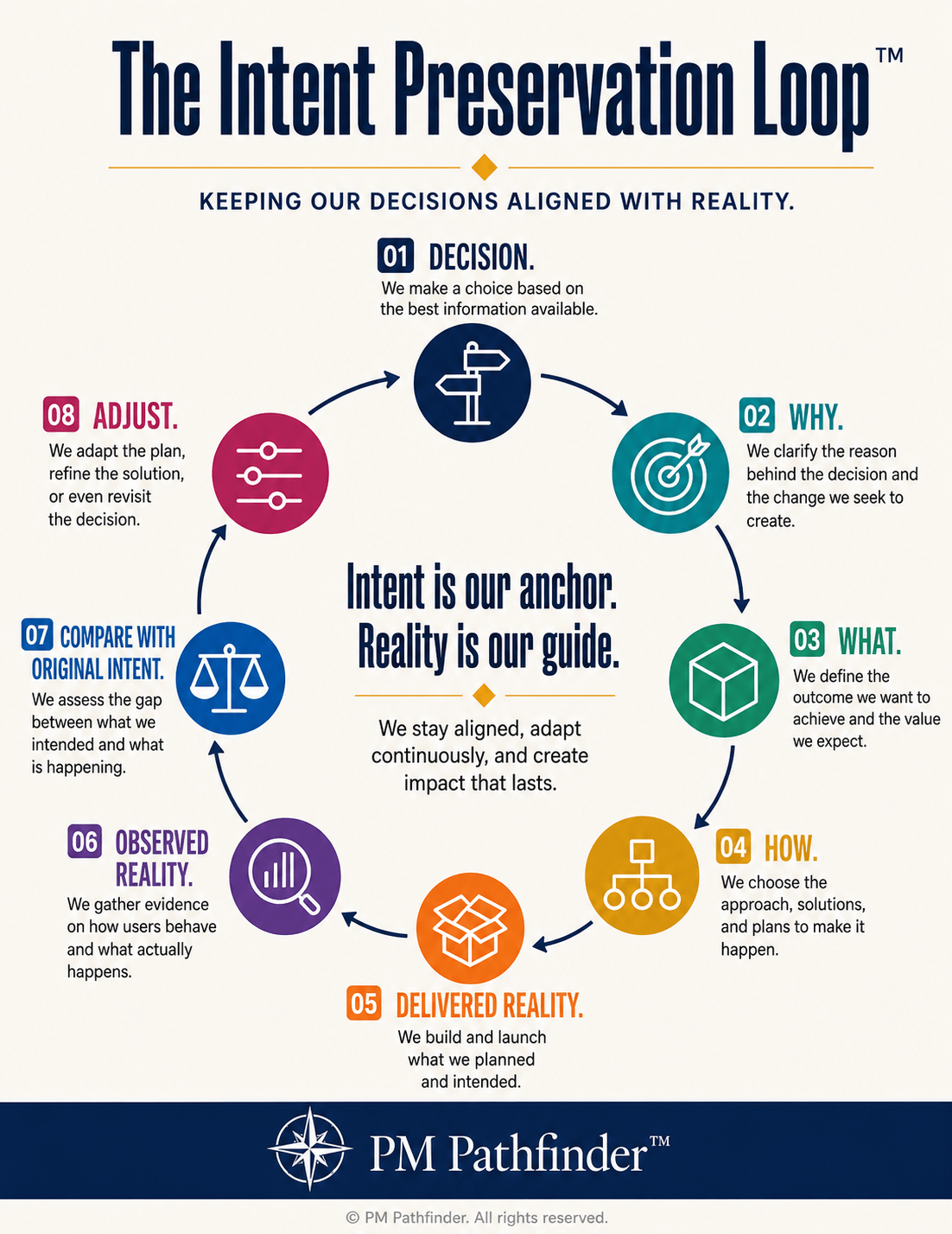
Where the Decision Translation Model is diagnostic, the Intent Preservation Loop is operational — a repeated discipline, not a stage-gate process. It’s meant to be run by a team, on a single initiative, at any point during execution, to reconnect the emerging reality to the original decision.
1. Decision
Begin with the current decision.
Not just the initiative name. Not the epic. Not the release.
State the actual choice.
For example: We will simplify the first-user journey because early behavioural signals show that users are abandoning the product before reaching its core value.
This creates a stronger execution anchor than: Improve onboarding.
2. Why
The “why” protects meaning.
It explains the user problem, the business relevance, the evidence, the urgency, and the intended change.
Teams often document the “what” thoroughly while the “why” survives only in the memories of a few people.
That is fragile.
As people change, scope evolves, and pressure increases, the work remains while the reason disappears.
A practical test: Can the people doing the work explain why the decision matters without reading the original strategy document?
If not, intent is already weakening.
3. What
The “what” defines the change the organisation is trying to create.
This should not be limited to features.
It may be a new user behaviour, reduced friction, a faster operational process, better decision quality, greater trust, lower failure risk, increased adoption, or clearer customer understanding.
When the “what” is framed as an outcome, the team has room to adapt the solution.
When it is framed only as a deliverable, execution becomes brittle.
4. How
The “how” is the implementation.
It includes product design, technical architecture, workflows, operating models, communications, rollout plans, policies, AI behaviour, and measurement.
This layer should remain flexible.
The “how” is where teams exercise expertise.
But flexibility should not become separation from intent.
Every implementation choice should still be traceable to the change being pursued.
5. Delivered Reality
This is what the organisation actually created.
Not what the roadmap described. Not what the team intended. What exists now?
What was included? What was removed? What compromises were made? What changed during delivery?
This stage requires honesty.
Many teams compare delivery against scope.
Signal-led teams compare delivery against intent.
6. Observed Reality
What are users and systems actually doing?
This requires multiple forms of evidence: behavioural analytics, customer conversations, support patterns, operational data, performance signals, qualitative feedback, adoption and retention, unexpected workarounds, and downstream consequences.
Observed reality may differ from both the plan and the delivered experience.
Users may interpret the product differently.
They may use it in unexpected ways.
They may reject the intended behaviour.
They may achieve value through a route the team did not anticipate.
Reality gets the final vote.
7. Compare With Original Intent
This is the discipline most execution systems overlook.
Ask: Did the delivered experience preserve the original purpose? Did the intended behaviour change? Did we solve the problem or only release the capability? Which assumptions were validated? Which trade-offs changed the outcome? Are users experiencing what we expected? Has new evidence made the original decision less relevant?
The comparison should not become a search for blame.
It should become a source of clarity.
8. Adjust
Adjustment may mean refining the experience, changing the scope, improving communication, strengthening instrumentation, reversing a trade-off, changing the implementation, revisiting the priority, stopping the initiative, or making a new decision.
Signal-led execution is not committed to defending the original plan.
It is committed to improving the relationship between intention and reality.
That distinction creates learning without chaos.
How the Two Models Work Together
| The Decision Translation Model™ | The Intent Preservation Loop™ | |
|---|---|---|
| Role | Diagnostic | Operational |
| Question | Where did the decision lose clarity? | Are we still solving the same problem? |
| Unit of analysis | The organisation, across functions | The work, at any point in time |
| Shape | One-directional, stage to stage | Circular, run repeatedly |
Use the Decision Translation Model to locate which translation stage introduced a gap — interpretation, prioritisation, coordination, delivery, experience, or measurement.
Use the Intent Preservation Loop to keep a specific piece of work honest as it moves, and to decide what to adjust once you’ve found the gap.
Together: the Decision Translation Model reveals how intent can be lost. The Intent Preservation Loop helps teams keep finding it again.
Five Disciplines of Strong Execution
Frameworks become useful only when they influence behaviour. Five disciplines turn the two models into everyday practice:
1. Preserve the decision rationale. Don’t let the decision become a title in a roadmap. Capture the problem, the evidence, the intended outcome, and the reversal conditions — a one-page decision record beats a long requirements document that explains everything except why the work exists.
2. Treat handoffs as interpretation moments, not information transfers. Sharing information doesn’t create shared meaning. Ask each function to explain the decision back in their own words. Misunderstandings caught early are alignment; misunderstandings discovered after launch are rework.
3. Make trade-offs visible. Trade-offs aren’t defects — they’re part of the work. The problem is when they go undocumented. For each real compromise, record what changed, why, and whether the original decision still holds.
4. Instrument the outcome, not just the release. Decide how success will be measured at the decision stage, not at launch. Screens shipped and tickets closed prove delivery. Time to first value, user confidence, and support dependence prove the outcome actually happened.
5. Create deliberate reconnection points. Delivery checkpoints ask “are we on track.” Intent checkpoints ask “is this still worth the effort we’re investing” — a project can be on track while the outcome quietly drifts. Build in a few of these on purpose: after discovery, before major scope commitment, before launch, after early signals.
A Practical Example
I’ve watched a version of this play out more than once, and it tends to follow the same shape.
A product team sees a recurring signal: new customers are taking too long to configure the product, and many abandon the process before reaching value.
The decision is: Reduce first-user complexity so new customers reach a meaningful outcome faster and with greater confidence.
Translation begins. Leadership interprets this as improved conversion. Product interprets it as fewer onboarding steps. Design interprets it as a cleaner interface. Engineering interprets it as workflow simplification. Sales interprets it as easier implementation. Support interprets it as fewer setup questions.
All of these interpretations are related. But they are not identical.
Prioritisation changes the work. Because of a deadline, the team removes two screens but keeps the underlying setup complexity. The scope becomes: launch a shorter onboarding flow.
The team delivers on time. The release is considered successful.
But behavioural data shows that users still pause, leave, and contact support.
Why? Because the number of screens was not the real problem. The original signal pointed to cognitive and configuration complexity, not merely journey length.
The team delivered the prioritised output. It did not create the intended reality.
Applying the models. The Decision Translation Model identifies the distortion during prioritisation: “reduce complexity” became “reduce screens.” The Intent Preservation Loop reconnects the team to the original why: help users reach value with confidence.
The team then reviews observed reality and adjusts: improve setup guidance, remove unnecessary decisions, preconfigure defaults, explain trade-offs, introduce progressive disclosure, and measure time to first value and support dependency.
Execution improves not because the team works faster.
It improves because reality is repeatedly compared with intent.
What Product Managers Actually Own in Execution
Product Managers do not execute every task.
They do not own every dependency.
They do not control every implementation decision.
But they carry a distinctive responsibility: they help the organisation preserve the meaning of the decision while the work changes shape.
That means keeping the problem visible, protecting the intended outcome, making trade-offs explicit, connecting functions around shared reality, ensuring measurement reflects value, bringing new signals back into the work, and challenging delivery that no longer supports the purpose.
This is not project tracking.
It is decision stewardship.
They are the people who help teams adapt without losing the reason the work exists.
Execution in the Age of AI
AI changes the execution environment in two ways that map directly onto the model above:
It accelerates translation — requirements into designs, designs into prototypes, analysis into summaries, all faster — and it accelerates distortion at the same rate.
Ambiguous intent now generates polished, confident, misaligned output quickly, and local optimisations can scale before anyone notices the consequence.
AI doesn’t remove any of the eight stages in the Decision Translation Model. It just moves through Interpretation, Prioritisation, and Execution faster — which means a distortion introduced early has less time to be caught before it’s live.
AI can shorten the distance between instruction and action. It cannot guarantee that the instruction deserved to become reality. That judgment call is still, and remains, a human one.
Signs Your Decision Is Losing Meaning
A decision may be drifting when:
- teams can describe the deliverable but not the problem;
- success metrics are mostly activity measures;
- scope changes are made without revisiting the outcome;
- different functions use conflicting definitions of success;
- the roadmap remains stable while customer evidence changes;
- trade-offs are remembered informally but not examined collectively;
- launch readiness receives more attention than outcome readiness;
- teams defend the solution because of effort already invested;
- nobody can explain which signal would cause the decision to change.
These are not merely execution symptoms.
They are signs that the connection between intent and reality is weakening.
Final Reflection
Every important product decision begins as an interpretation of reality.
A signal is noticed → Meaning is constructed → A direction is chosen
Then the decision enters an organisation full of constraints, expertise, incentives, dependencies, assumptions, and competing priorities.
It changes shape.
That is normal.
The goal of execution is not to preserve the first version of the plan untouched.
The goal is to ensure that every change remains conscious and every compromise remains connected to purpose.
Because the real test of a decision is not whether it survived the meeting.
It is whether it survived the journey into experience.
The strongest teams are not simply better at shipping.
They are better at carrying intent through uncertainty.
They know what must remain true.
They know what can change.
They observe what reality is teaching them.
And they adjust before momentum turns drift into outcome.
Execution is not the work that happens after a decision.
Execution is the process that allows a good decision to survive contact with reality.
If any of this feels familiar — in your product, your team, or your organization — I’m always open to a thoughtful conversation.
Thanks for Reading 🙏
🧭 A decision creates direction.
Execution determines whether that direction becomes real.
The challenge is not to eliminate interpretation, trade-offs, or change.
It is to preserve enough intent through them that the experience users receive still solves the problem the organisation set out to address.
Because delivery proves that something was built.
Only reality proves that it mattered.
Explore all articles at www.thepmpathfinder.com.
Leave a Reply