
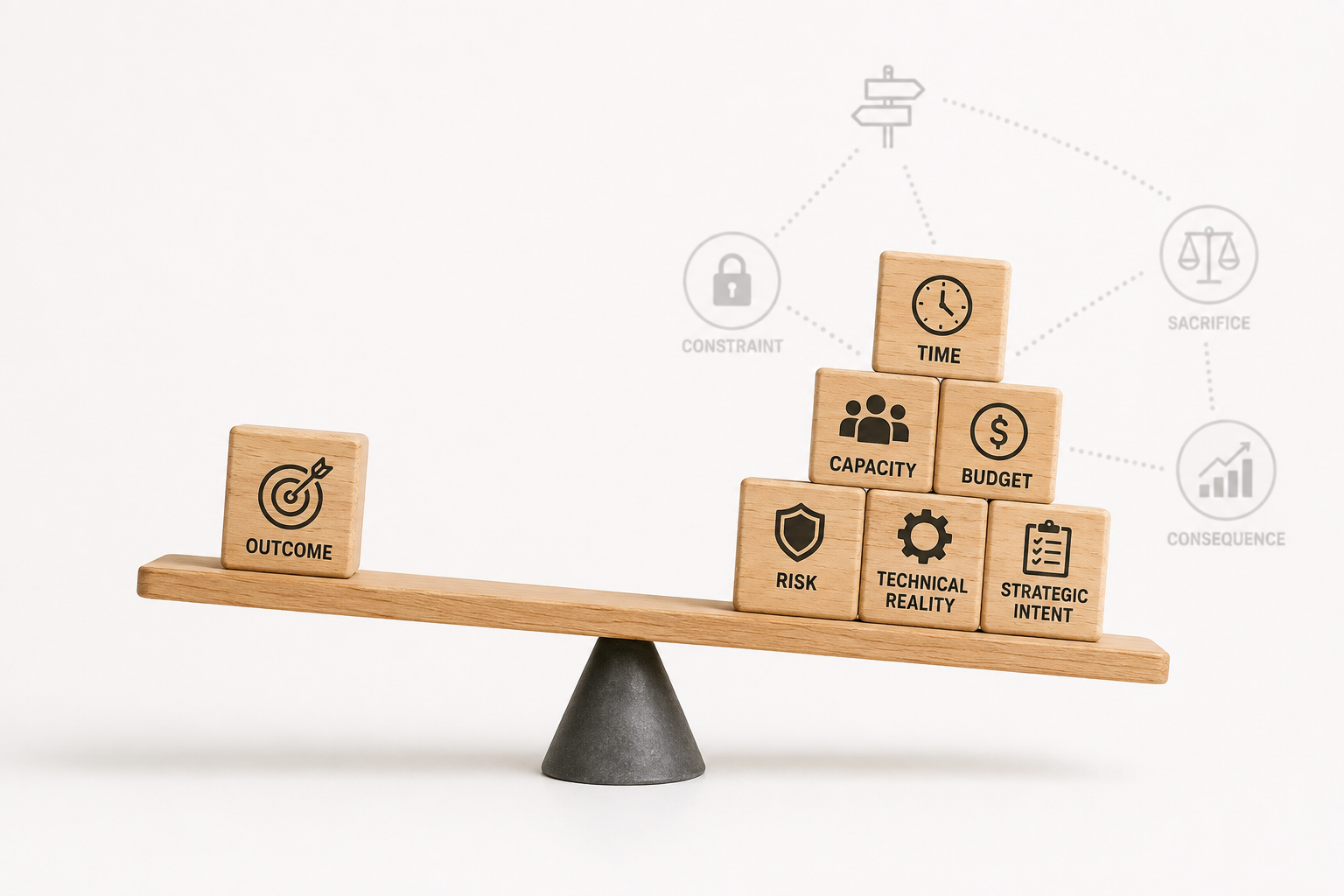
How strong product decisions are made when everything cannot move at once.
There is a moment in almost every serious product initiative when the conversation changes.
Until that point, everyone is discussing what the product should become.
Then reality enters the room.
The deadline cannot move.
The architecture is not ready.
The regulatory requirement is non-negotiable.
Engineering capacity is limited.
A customer commitment already exists.
The data is not trustworthy enough.
The team wants speed.
Leadership wants confidence.
Users want simplicity.
And suddenly the question is no longer:
“What is the best solution?”
It becomes:
“Given what is true right now, what are we willing to protect — and what are we willing to give up?”
That is where product decision-making becomes real.
Because product management is not the practice of choosing in a world of unlimited options.
It is the practice of making intelligent choices inside constraints.
And the quality of those choices depends not only on what we select.
It depends on whether we understand what is constraining the decision, what we are sacrificing, and what consequences that sacrifice creates.
A Trade-off Is Not What Happens When the Plan Goes Wrong
Trade-offs are often discussed as if they are an unfortunate consequence of limited resources.
We would build everything if we had enough engineers.
We would make the experience perfect if the deadline were flexible.
We would solve the technical debt if there were more time.
We would investigate more deeply if stakeholders were not asking for delivery.
That framing is comforting.
It suggests that somewhere there is a version of product management where constraints disappear and the objectively correct decision becomes obvious.
There isn’t.
Every meaningful product decision protects something at the expense of something else.
Speed may come at the expense of flexibility.
Consistency may reduce local optimisation.
Short-term conversion may affect trust.
Standardisation may reduce autonomy.
A simpler experience may exclude advanced use cases.
Building a stronger foundation may delay the visible feature everyone is waiting for.
These are not exceptions to product work.
They are the substance of product work.
A trade-off is not what remains after the decision.
I Learned This Most Clearly When “Smaller” Was Actually the More Ambitious Choice
In one global energy programme I worked on, the long-term ambition covered terminal operations across Europe and Asia.
The system needed to create something that had barely existed before: reliable, continuous operational awareness from a fragmented environment of manual checks, disconnected systems, inconsistent definitions, and missing real-time data.
The destination was large.
But we deliberately started with five terminals.
From the outside, that could easily look like a constrained version of the real ambition.
Why only five?
Why not prove the architecture across the full estate?
Why not demonstrate visible scale earlier?
But the five-terminal scope was not a compromise forced on the programme.
It was a trade-off we chose.
We were protecting learning quality and recoverability over visible scale.
A data pipeline that breaks while serving five terminals is relatively cheap to diagnose.
A data-definition problem discovered across five sites can still be corrected before it becomes embedded.
A workflow failure inside a contained proof of concept is learning.
The same failure after global rollout is operational disruption, production rework, stakeholder disappointment, and lost trust.
So the decision was not:
Five terminals versus fifty terminals.
The deeper decision was:
Where do we want the system to encounter failure — while failure is still cheap, or after failure becomes expensive?
That changed how I thought about constraints.
A smaller scope does not always mean a smaller ambition.
Sometimes it is the mechanism that protects the larger one.
The POC was deliberately designed to expose failure modes before they became production-scale problems, while governance was embedded from the beginning so that the smaller starting scope would not create structural rework when the system expanded.
Constraints Shape the Decision Space
Product teams often treat constraints as information that arrives after the ideal solution has been defined.
First decide what we want.
Then ask what reality will allow.
But strong product thinking works in the opposite direction.
Constraints are part of the problem definition.
They shape what “good” can realistically mean.
Imagine two teams solving the same customer problem.
One operates in a lightly regulated consumer environment where a failed experiment can be reversed within hours.
The other operates inside a heavily governed enterprise environment where security, auditability, access controls, and operational continuity apply from the first release.
The same idea may produce completely different decisions.
Neither team is necessarily less innovative.
They operate inside different decision spaces.
The constraint does not automatically make one option worse.
It changes the criteria by which “better” should be judged.
This is why experienced product managers ask early:
What is genuinely fixed here?
What can move?
What appears fixed but has never actually been challenged?
And:
Which constraint matters enough that the rest of the decision should organise around it?
Not Every Constraint Is Actually Fixed
This distinction matters because organisations often treat inherited assumptions as if they were laws of physics.
I find it useful to separate constraints into four types.
1. Hard Constraints
These are genuinely non-negotiable within the current decision.
A regulatory requirement.
A safety condition.
A contractual obligation.
A legal boundary.
A production dependency that physically cannot be removed inside the available window.
You do not optimise around whether these exist.
You optimise around how intelligently you operate within them.
2. Soft Constraints
These are real, but movable at a cost.
Budget.
Timeline.
Team capacity.
Scope.
Performance targets.
A soft constraint can move, but moving it affects something else.
This is where the actual trade-off becomes visible.
If the date must remain fixed, perhaps scope moves.
If scope remains fixed, perhaps capacity or risk moves.
If quality cannot move, the launch date may have to.
3. Self-Imposed Constraints
These exist because of an earlier decision.
“We promised the roadmap.”
“We built around this architecture.”
“We selected this operating model.”
“We standardised on this platform.”
These constraints may be completely rational.
But they should not be confused with permanent truth.
Yesterday’s decision can become today’s boundary.
That does not automatically mean the boundary should be removed.
It means we should remember where it came from.
4. Assumed Constraints
These are the most dangerous.
“Leadership will never approve that.”
“Customers need all of these features.”
“We have to launch this quarter.”
“The region will never standardise.”
“The platform cannot support it.”
Sometimes those statements are true.
Sometimes they are simply beliefs that have survived because nobody has tested them.
Strong PMs do not challenge every constraint for the sake of challenging it.
But they do ask:
Is this fixed, movable, inherited, or merely assumed?
That question alone can reopen decision spaces that appeared closed.
The Trade-off Lens™

When a material product decision becomes difficult, I use six questions to make the decision more explicit.
Outcome → Constraint → Options → Sacrifice → Consequence → Reversibility
Each layer forces a different kind of clarity.
1. Outcome — What Are We Trying to Protect?
A trade-off only makes sense relative to an outcome.
Suppose a team is debating whether to reduce scope before launch.
That debate is impossible to resolve intelligently without knowing what must be protected.
Are we protecting:
- the customer outcome?
- a contractual date?
- system reliability?
- regulatory compliance?
- learning speed?
- revenue?
- strategic credibility?
- future architectural flexibility?
Different protected outcomes produce different decisions.
This is why “What should we cut?” is often the wrong first question.
Ask instead:
“What cannot be allowed to fail?”
That gives the trade-off a reference point.
2. Constraint — What Is Actually Limiting Us?
Once the outcome is clear, identify the constraint shaping the decision.
Do not say:
“We don’t have enough time.”
Ask:
Enough time for what?
Perhaps the problem is not time.
Perhaps it is unresolved architecture.
Perhaps the team cannot test safely.
Perhaps stakeholder decisions arrived late.
Perhaps the data foundation is unreliable.
Perhaps the scope contains too many unknowns.
Naming the wrong constraint produces the wrong trade-off.
3. Options — What Viable Choices Actually Exist?
Teams frequently compare:
The preferred option
versus
doing nothing.
That is rarely the full decision space.
Could we:
- reduce scope?
- sequence differently?
- pilot?
- make the decision reversible?
- change the operating process instead of the product?
- preserve the foundation and delay the visible layer?
- solve the highest-risk portion first?
- create a manual bridge while learning?
- make the system observable before automating it?
A good product decision does not require unlimited options.
It requires enough viable alternatives that the organisation is genuinely choosing rather than simply accepting the first proposed path.
4. Sacrifice — What Are We Deliberately Giving Up?
This is where many organisations become uncomfortable.
Priorities sound positive.
Sacrifices do not.
“We are prioritising the enterprise segment.”
sounds strategic.
“We are therefore accepting that some SMB use cases will receive less attention this cycle.”
sounds harder.
But the second statement is the one that actually creates clarity.
If a decision has no visible cost, one of two things is usually true:
Either the decision was easy.
Or the cost has not yet been named.
If you cannot say what you are giving up, the trade-off is probably not explicit enough.
5. Consequence — Where Does the Cost Go?
This is where trade-off thinking needs to move beyond the immediate decision.
A cost does not disappear simply because it leaves the current backlog.
It often moves.
A shortcut in architecture may become slower delivery later.
A scope cut may increase support demand.
Automation may reduce routine work while increasing the proportion of complex exceptions humans must handle.
A stricter standard may improve global comparability while making local execution less flexible.
A faster launch may produce technical debt.
A delayed foundation may produce rework precisely when the organisation is trying to scale.
So ask:
What happens next because of this choice?
Not just:
What happens now?
6. Reversibility — How Hard Will This Be to Undo?
Not every decision deserves the same amount of deliberation.
A button label can be changed.
A feature flag can be reversed.
A limited pilot can be stopped.
A global data model is harder to unwind.
A deeply embedded architecture is harder still.
A customer promise may create commercial expectations that cannot simply be rolled back.
This should influence how much evidence we demand before deciding.
The more irreversible the decision, the more seriously we should examine the assumptions underneath it.
The more reversible the decision, the more comfortable we can be learning through action.
Product teams often do the opposite.
They over-analyse small reversible decisions.
And under-analyse structural decisions because momentum has already built around them.
The Cost You See Is Not Always the Cost You Pay
One of the most useful lessons from working in large systems is that trade-off costs appear in different places.
I think of three types.
Visible Trade-off
The cost is immediate and understood.
“We will delay Feature B in order to complete Feature A.”
Everyone can see it.
Deferred Trade-off
The cost is pushed into the future.
“We can skip the governance work now and solve it before production.”
The early project appears faster.
But the organisation has not removed the work.
It has delayed it—and often increased its eventual cost.
Displaced Trade-off
The cost moves somewhere else in the system.
A simpler operational workflow might shift complexity into support.
A faster customer experience might move verification work downstream.
A standardised global process might create additional burden for unusual local cases.
The product team may still report success because the cost has left the metric it was watching.
This is why trade-off decisions require systems thinking.
“Visible Progress” Can Be One of the Most Expensive Constraints
I encountered this in a different global transformation environment.
Leadership needed more reliable operational visibility across a large logistics network.
The attractive destination was obvious:
Dashboards.
Executive views.
Regional scorecards.
Predictive analytics.
Unified visibility.
Those were the things people could see.
And understandably, those were the things stakeholders wanted quickly.
But the underlying operational data was fragmented.
Definitions differed.
Some data lived in local spreadsheets and systems.
Some information travelled through manual consolidation chains.
The same metric could mean different things in different places.
So there was a decision to make.
We could optimise for visible progress and move quickly toward the reporting layer.
Or we could spend scarce time on work that was much less impressive to look at:
structured capture at source,
shared definitions,
data governance,
pipeline architecture,
access controls,
and reliable movement of data through the system.
The second route was harder to sell because foundations rarely look like progress while they are being built.
But the trade-off was clear.
We were giving up some immediate visibility of progress in order to protect future trust and scalability.
That meant holding a difficult line:
The programme therefore moved first toward structured data capture and standardisation, then pipeline architecture and governance, and only then toward the visibility and decision layer.
The case describes this explicitly as “visible outputs create excitement; foundations create trust.”
That was not merely an architecture decision.
It was a product trade-off.
And it taught me something that applies far beyond data platforms:
Sometimes the highest-value product decision is the one that temporarily makes progress less visible.
Good Trade-offs Protect Something Explicitly
There is a difference between sacrifice and compromise.
Compromise often means every side gives up something until everyone can live with the outcome.
A good trade-off is more intentional.
It says:
This is what we are protecting.
This is what we are willing to give up.
And this is why.
Consider:
“We are reducing scope.”
versus:
“We are protecting the launch date and core customer outcome, so we are removing two secondary workflows that can be added later without compromising the primary journey.”
The second statement tells the organisation how to reason.
That matters because trade-offs continue after the meeting.
Engineering will encounter another constraint.
Design will discover another edge case.
Sales will receive another request.
Operations will identify another exception.
If people understand what the original decision was trying to protect, they can make coherent downstream choices without escalating every conflict.
That is how explicit trade-offs create autonomy.
Constraints Can Improve Decisions
Constraints are usually discussed negatively.
But good constraints can improve product thinking.
A fixed time window may force the team to identify the smallest meaningful outcome.
Limited capacity can expose weak priorities.
A technical limitation can force a simpler experience.
A strict governance requirement can reveal architectural shortcuts that would otherwise have survived until scale.
A pilot boundary can make experimentation safer.
The important distinction is whether the constraint is helping us focus or merely limiting us unnecessarily.
Strong product leaders do not romanticise constraints.
Some constraints genuinely make good outcomes harder.
But they also do not assume that unlimited possibility produces better products.
It often produces indecision.
Useful constraints narrow the space enough that priorities become real.
Five Practices for Better Trade-off Decisions
1. Write Down What the Decision Protects
Before debating options, complete this sentence:
“The outcome we are unwilling to compromise is…”
If different stakeholders answer differently, the trade-off discussion is premature.
2. Name the Constraint Precisely
Replace:
“We need to move faster.”
with:
“The contractual launch date is fixed, which means scope or capacity must move.”
Replace:
“The architecture cannot support it.”
with:
“Supporting this use case would require changing X dependency, which would add Y risk to this release.”
Precision makes negotiation possible.
3. State the Sacrifice Alongside the Priority
Do not communicate:
Priority: improve reliability.
Communicate:
Priority: improve reliability; consequence: feature expansion will slow this cycle.
Every priority should make its cost visible.
4. Look for Deferred and Displaced Costs
Ask two questions:
“What are we pushing into the future?”
and
“Where else in the system might this cost appear?”
These questions expose many attractive short-term decisions before they become expensive long-term ones.
5. Match Decision Effort to Reversibility
For reversible decisions:
move,
observe,
learn.
For hard-to-reverse decisions:
slow down enough to understand the assumptions, consequences, and failure modes.
Do not confuse speed with decisiveness.
Sometimes decisiveness means moving quickly.
Sometimes it means refusing to accelerate a decision whose cost will be difficult to unwind.
Trade-offs Should Survive the Meeting
Many product conflicts that appear months later are actually old trade-offs that were never documented.
Leadership remembers the strategic reason.
Engineering remembers the scope cut.
Sales remembers the customer commitment.
Design remembers the experience compromise.
Operations remembers the exception that was accepted.
Each remembers a different part.
Eventually someone asks:
“Why did we decide this?”
And nobody has the full answer.
For material decisions, the record does not need to be complicated.
Capture:
Decision — What did we choose?
Protected outcome — What were we optimising for?
Constraint — What shaped the choice?
Sacrifice — What did we consciously give up?
Consequence — What risk or downstream effect did we accept?
Revisit trigger — What would cause us to reconsider?
That is not bureaucracy.
It preserves the reasoning that allowed the decision to make sense.
The Product Manager’s Role Is Not to Remove Every Constraint
Product managers are often expected to “unblock” teams.
Sometimes that is exactly the right job.
Remove unnecessary process.
Resolve ownership.
Challenge assumptions.
Escalate decisions.
Find additional capacity.
But not every constraint should be removed.
Some exist for a reason.
Security.
Trust.
Quality.
Safety.
Regulation.
Strategic focus.
Technical integrity.
The PM’s job is not to create a world in which nothing constrains the team.
It is to distinguish between:
constraints that should be challenged,
constraints that should be negotiated,
and
constraints the product must respect.
That requires judgment.
And judgment is what turns prioritisation from backlog administration into product leadership.
Final Reflection
The hardest product decisions rarely look like:
Option A or Option B?
They look more like:
Which outcome matters most right now?
What is actually constraining us?
Which cost are we willing to accept?
Where will that cost appear later?
How difficult will this choice be to reverse?
That is why mature product decision-making is not about eliminating trade-offs.
It is about making them visible enough that the organisation understands what it is choosing.
Because every meaningful decision has a cost.
The danger is not that the cost exists.
The danger is pretending it does not.
It is the ability to make intelligent choices inside them — without hiding what those choices cost.
And perhaps that is the real discipline behind prioritisation:
Not deciding what matters.
But deciding what matters enough to give something else up for it.
Continue Exploring This Perspective
What Makes a Good Product Decision
Why strong decisions depend less on certainty and more on context, judgment, assumptions, and the quality of the reasoning behind the choice.
Why Clarity Is the Most Underrated PM Skill
Why reality, intent, decisions, and trade-offs must become explicit enough for different teams to act coherently inside complexity.
Speed vs Direction: The Modern Product Dilemma
Why moving faster does not automatically create progress — and why direction matters most when teams are under pressure to accelerate.
If any of this feels familiar — in your product, your team, or your organization — I’m always open to a thoughtful conversation.
Thanks for Reading 🙏
🧭Product decisions become real when something has to give.
The goal is not to eliminate constraints or avoid sacrifice.
It is to understand what the decision protects, what it costs, and what that cost may create next.
Explore all articles at www.thepmpathfinder.com.
Leave a Reply