
Why Interpretation Is the Real Product Advantage
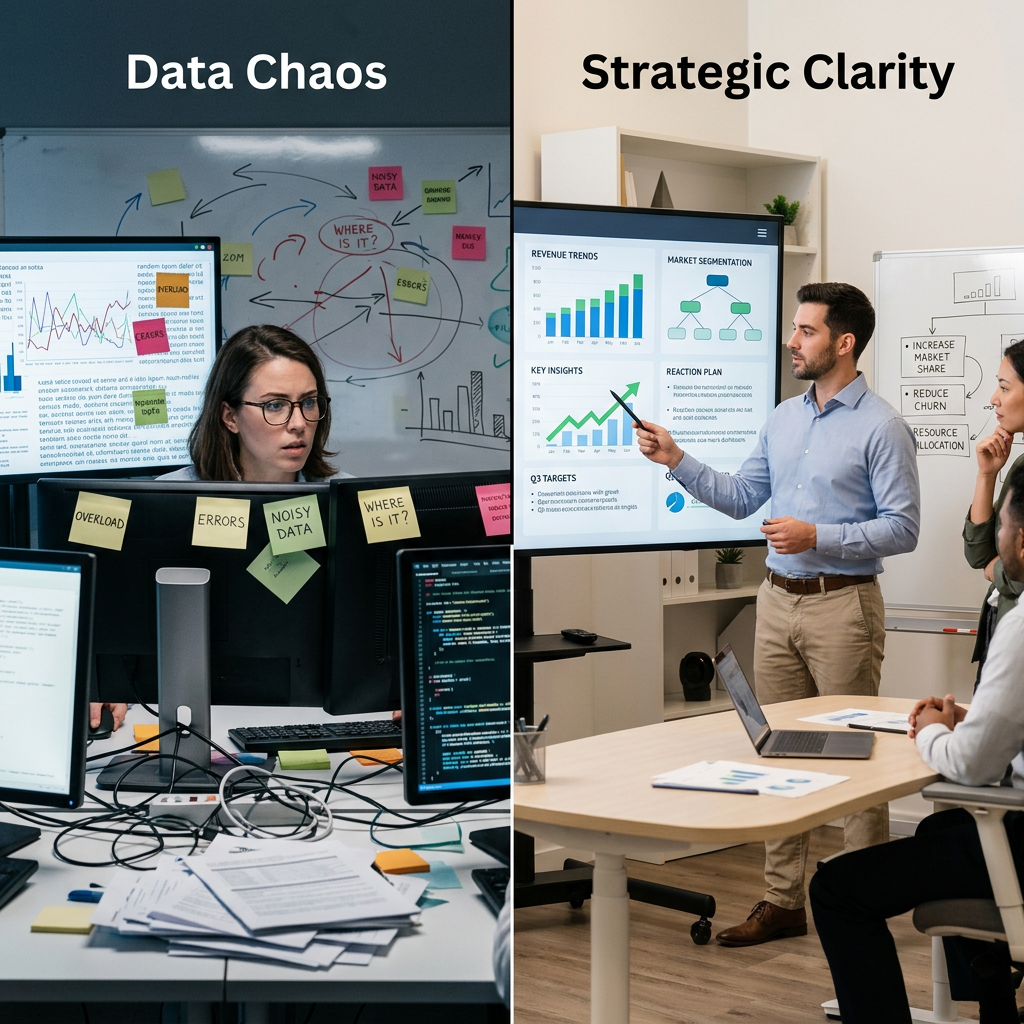
Most product teams today are not operating in a data shortage.
They are operating in an interpretation crisis.
AI tools summarize feedback instantly.
Analytics platforms track every click, drop-off, and conversion path.
Customer conversations generate endless streams of insight.
And yet — despite all this visibility — many teams still make poor product decisions.
Why?
Because signals alone do not create understanding.
Interpretation does.
It is the ability to extract meaning from it.
That is the layer most organizations still underestimate.
The Same Signal. Different Outcomes.
Two companies notice the same metric:
User activation rates dropped by 18%.
The first team responds by focusing primarily on rapid corrective action..
- Launch onboarding tooltips
- Add reminder notifications
- Prioritize emergency UX changes
- Escalate delivery timelines
Velocity increases.
Stress increases.
Meetings multiply.
But activation continues falling.
The second team pauses before reacting.
Instead of asking:
“How do we fix the metric?”
They ask:
“What changed in user behavior?”
After deeper investigation, they discover something unexpected:
The issue was not onboarding friction.
A recent workflow update had quietly changed how users interpreted the product’s value during setup.
The signal was real.
But the meaning behind the signal was different.
Different interpretation.
Completely different decisions.
This is the difference between reacting to signals and understanding them.
The Modern Illusion: “We Have Data, So We Understand”
Modern product organizations often confuse visibility with clarity.
Because dashboards create the feeling of awareness.
But awareness is not understanding.
Many teams today are drowning in:
- metrics
- AI-generated summaries
- user feedback streams
- engagement charts
- performance alerts
- behavioral analytics
Yet decision quality often remains shallow.
Because data can tell you:
- what happened
- where users clicked
- how long sessions lasted
- which funnel dropped
But it cannot independently explain:
- why behavior changed
- what users actually felt
- whether the signal is structural or temporary
- what second-order effects may emerge
- which tradeoff matters most
That layer still requires interpretation.
And interpretation requires judgment.
Modern teams don’t suffer from lack of information.
They suffer from premature conclusions.
The Signal → Insight → Decision Model

One of the biggest mistakes product teams make is collapsing multiple thinking layers into one.
A signal is not an insight.
And an insight is not automatically a decision.
The progression actually looks like this:
| Layer | What It Represents | Core Risk |
|---|---|---|
| Signal | Raw observation | Noise |
| Pattern | Repeated behavior | False correlation |
| Insight | Interpreted meaning | Bias |
| Decision | Strategic response | Misalignment |
| Outcome (Interpretation Layer) | Observable impact requiring further interpretation | Premature conclusions |
This distinction matters enormously.
Because weak teams react at the signal layer.
Strong teams operate at the interpretation layer.
They understand:
- not every spike matters
- not every drop is a crisis
- not every request reflects the real need
- not every metric movement deserves intervention
They treat them as new signals requiring deeper interpretation.
In adaptive product systems, outcomes are never final answers.
They are the beginning of the next interpretation cycle.
The real craft of product thinking begins between signal and decision.
That space is where interpretation lives.
The Interpretation Layer
This is where exceptional Product Managers separate themselves from operational PMs.
Most teams ask:
“What happened?”
Strong product thinkers ask:
- Why now?
- What changed around this behavior?
- Is this local or systemic?
- Is this symptom or root cause?
- Is this friction or expectation mismatch?
- Is this temporary noise or directional movement?
- What signal are we missing completely?
Interpretation is not passive analysis.
It is active sensemaking.
It requires:
- context
- systems thinking
- behavioral understanding
- strategic awareness
- organizational memory
- product intuition
Because metrics rarely arrive with explanations attached.
A retention drop might mean:
- onboarding confusion
- pricing misalignment
- degraded performance
- changing market expectations
- competitor movement
- poor feature discoverability
- broken trust
- or simply seasonal behavior
The same signal can produce entirely different decisions depending on interpretation quality.
They are organizational sensemakers.
Why Smart Teams Still Misinterpret Signals
Access to data does not guarantee clarity.
In fact, many intelligent teams consistently misread signals because of structural thinking gaps.
1. Metric Myopia
Teams optimize what is measurable instead of what is meaningful.
This often creates:
- feature factories
- vanity KPI obsession
- surface-level optimization
- false momentum
A rising engagement metric does not automatically mean rising user value.
Sometimes users interact more because they are confused.
2. Context Collapse
Signals detached from human context become dangerous.
A dashboard might show:
“Users abandoned step three.”
But dashboards cannot fully reveal:
- emotional friction
- trust breakdown
- cognitive overload
- expectation mismatch
Behavior without context is incomplete intelligence.
3. Confirmation Bias
Sometimes teams stop exploring signals objectively — and start looking for evidence that supports what they already believe.
For example:
If leadership strongly believes a feature is important, teams may unconsciously interpret every positive metric as proof of success while ignoring signals that suggest friction, confusion, or weak adoption.
The danger is subtle.
Instead of asking:
“What is the data actually telling us?”
Teams begin asking:
“How do we justify the direction we already chose?”
That’s when interpretation becomes validation instead of investigation.
And over time, products stop learning from reality — because they start protecting assumptions instead.
4. Velocity Pressure
Fast-moving organizations often skip interpretation depth entirely.
Everything becomes:
- react
- prioritize
- ship
- optimize
- repeat
But speed without reflection creates noisy product evolution.
Not intelligent product evolution.
5. AI Over-Reliance
AI can summarize patterns extremely well.
But summarization is not strategic interpretation.
AI may detect:
- recurring phrases
- sentiment changes
- behavioral anomalies
- usage clusters
But it still lacks:
- organizational nuance
- long-term strategic awareness
- political context
- emotional interpretation
- product judgment
AI accelerates signal detection.
Humans remain responsible for meaning.
The New PM Capability: Interpretive Intelligence
The next generation of Product Managers will not differentiate themselves by access to tools.
Everyone now has tools.
The differentiator will be:
Interpretive Intelligence.
Interpretive Intelligence is:
The ability to:
- connect fragmented signals
- identify hidden meaning
- separate noise from directional movement
- detect second-order effects
- contextualize behavioral patterns
- frame strategic clarity under uncertainty
This goes beyond analytical thinking.
Because analytics answers:
“What is happening?”
Interpretive intelligence asks:
“What does this actually mean for the product, the user, and the future direction?”
That capability is becoming one of the most valuable skills in modern product leadership.
Especially in AI-augmented environments.
The SIGNAL Framework:
A Practical Model for Product Interpretation

Strong product teams do not react to every signal they see.
They interpret signals systematically.
Because raw data alone rarely explains:
- what changed,
- why it changed,
- whether it matters,
- or what action deserves attention.
That’s where interpretation frameworks become critical.
The SIGNAL Framework is designed to help Product Managers move beyond surface-level analytics and think more clearly in signal-rich environments.
Not every metric movement deserves a reaction.
Not every pattern deserves prioritization.
The goal is not faster reactions.
The goal is better judgment.
Here’s a simple framework:
SIGNAL
| Step | Focus Area | Key Question |
|---|---|---|
| S — Spot the Shift | Detect meaningful movement | What changed unexpectedly? |
| I — Investigate Context | Understand surrounding conditions | What else changed around this signal? |
| G — Group Related Signals | Connect patterns instead of isolated events | Is this part of a broader behavioral trend? |
| N — Navigate Root Causes | Separate symptoms from underlying drivers | What is actually creating this outcome? |
| A — Assess Strategic Impact | Evaluate business, user, and system implications | Does this meaningfully affect direction or priorities? |
| L — Lead with Intentional Action | Respond thoughtfully instead of reactively | What response creates the most clarity and value? |
Applying the Framework in Practice
A less mature interpretation approach might focus too quickly on surface-level explanations.
The early assumption could become:
“The increase in support tickets is likely caused by feature instability.”
As a result, discussions begin focusing primarily on:
- technical validation,
- rollback considerations,
- or incremental fixes.
But signal-led teams take a broader interpretive view before deciding how to respond.
Instead of reacting to the signal in isolation, they examine:
- surrounding behavioral changes,
- workflow impact,
- user expectations,
- and related patterns across the product experience.
From Observation to Understanding: Applying the SIGNAL Framework
Spot the Shift
Support tickets increased sharply within 72 hours of release.
Investigate Context
The feature itself was functioning correctly.
But the release also changed several long-standing workflows users were already familiar with.
Group Related Signals
Session recordings, user feedback, and adoption analytics revealed a pattern:
- users were not confused by the feature,
- they were confused by the changed behavior surrounding it.
Navigate Root Causes
The real issue wasn’t technical instability.
The product unintentionally disrupted user expectations and learned habits.
Assess Strategic Impact
If unresolved, the issue could:
- reduce user trust,
- increase support dependency,
- slow adoption,
- and create internal pressure to roll back a strategically valuable feature.
Lead with Intentional Action
Instead of removing the feature, the team:
- improved contextual guidance,
- simplified workflow transitions,
- and redesigned the change communication experience.
The outcome:
- support volume stabilized,
- adoption recovered,
- and users adapted successfully over time.
Why This Framework Matters
Modern PM environments are flooded with:
- dashboards,
- alerts,
- AI-generated summaries,
- customer feedback,
- and continuous optimization signals.
Without interpretation discipline, teams start reacting emotionally to noise.
The SIGNAL framework creates:
- structured thinking,
- contextual interpretation,
- and calmer decision-making under uncertainty.
Because strong product organizations are not defined by how quickly they react.
They are defined by:
“how clearly they understand what truly matters before acting.”
AI Changes Signal Detection — Not Human Responsibility
One of the biggest misconceptions about AI in product management is the belief that AI will eventually replace product judgment.
It won’t.
AI dramatically improves:
- clustering
- summarization
- anomaly detection
- pattern recognition
- predictive visibility
But it does not eliminate the need for human interpretation.
Because products exist inside:
- human expectations
- organizational systems
- emotional experiences
- cultural behavior
- strategic tradeoffs
And those layers still require human judgment.
The future PM is not the person competing against AI.
The future PM is the person who knows:
- when to trust signals
- when to challenge them
- when to slow down interpretation
- and when to act decisively despite ambiguity
The Teams That Win Will Interpret Better
The future advantage in product organizations will not belong to teams with the most dashboards.
It will belong to teams that understand reality more clearly than others.
Because signals are now abundant.
Meaning is scarce.
The strongest product organizations will become:
- better listeners
- better interpreters
- better sensemakers
- better contextual thinkers
Not just faster builders.
In a signal-saturated world:
interpretation becomes strategy.
but better organizational decisions.
Final Reflection
The modern PM is no longer just managing delivery.
Interpreting movement.
Connecting fragmented signals into strategic clarity.
Because products today are not static systems anymore.
The question is no longer:
“Do we have signals?”
The question is:
“Can we interpret them wisely?”
Because signals are everywhere now.
If these are challenges your team or organization is navigating too, I’m always open to thoughtful conversations.
Thanks for reading 🙏
🧭 In a world increasingly shaped by automation, AI systems, optimization loops, and constant noise — the ability to interpret reality clearly may become one of the most valuable competitive advantages of all.
Explore the full Learning Series at www.thepmpathfinder.com
Leave a Reply