
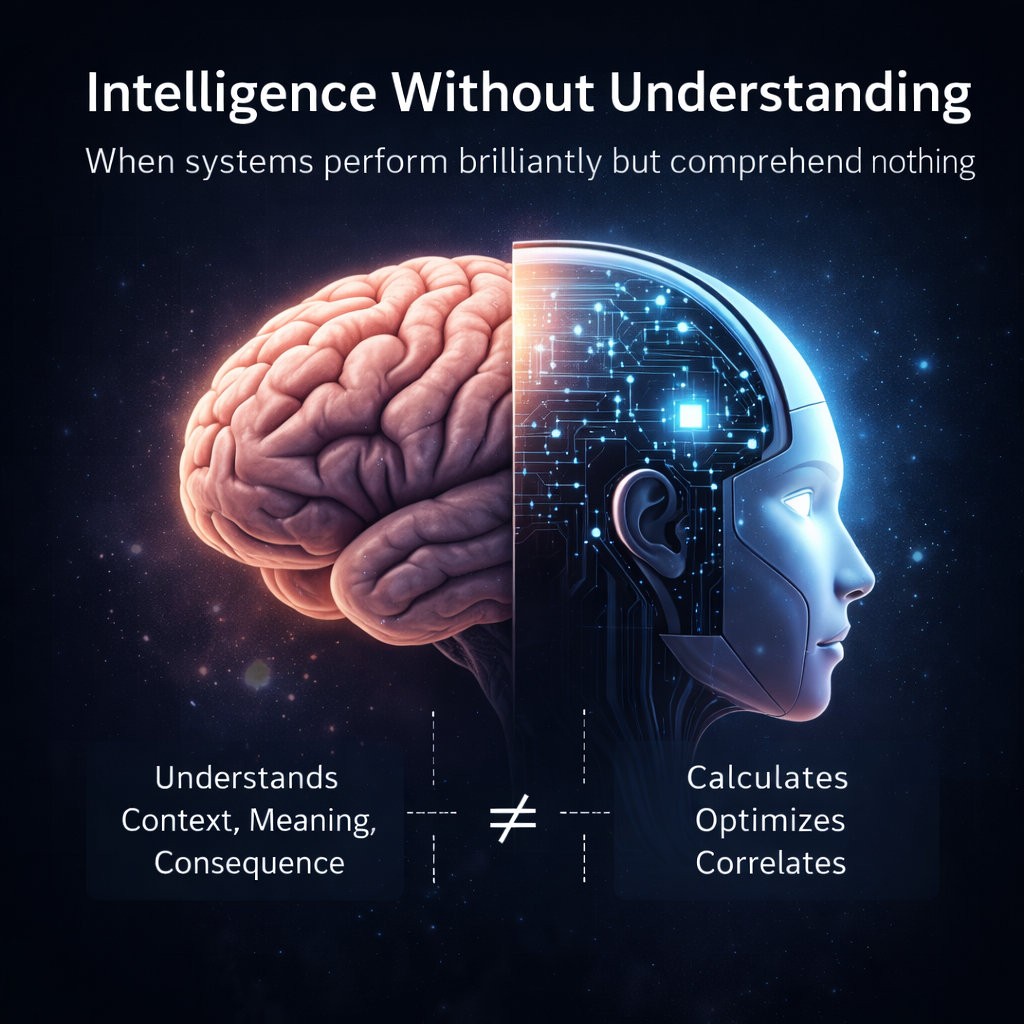
When systems perform brilliantly but comprehend nothing
A Strange New Competence
We are surrounded by systems that:
- Write essays
- Diagnose diseases
- Generate code
- Compose music
- Predict behavior
They perform at levels once reserved for experts.
And yet, something unsettling remains.
They do not understand what they are doing.
They calculate.
They correlate.
They optimize.
But they do not comprehend.
And that difference matters more than we admit.
For the first time in history, we have built entities that behave intelligently without possessing any interior life. They generate meaning without experiencing it. They simulate insight without awareness.
This is not a small technical detail.
It is a civilizational turning point.
The Performance Paradox
Modern AI systems are astonishingly capable.
They:
- Detect patterns across billions of data points
- Infer relationships humans would miss
- Adapt dynamically to new inputs
From the outside, this looks like intelligence.
But intelligence is not just output quality.
Intelligence — in the human sense — includes:
- Context
- Intent
- Meaning
- Moral awareness
- Self-reflection
Current systems simulate these traits convincingly.
They do not possess them.
They can explain a moral dilemma without feeling moral tension.
They can debate ethics without being accountable to consequences.
This is the paradox:
Systems that perform as if they understand — without ever understanding.
Performance has become detached from comprehension.
And when that detachment scales, our judgment becomes fragile.
What Understanding Actually Means
Understanding involves more than pattern recognition.
To understand something is to:
- Grasp cause and consequence
- Recognize context
- Hold multiple perspectives
- Revise belief based on reflection
- Know when you might be wrong
Understanding carries:
- Awareness of uncertainty
- Awareness of impact
- Awareness of responsibility
A system can generate a flawless explanation of grief.
It does not feel loss.
It does not comprehend mortality.
It does not know what grief means.
It predicts what words typically follow the idea of grief.
That is not the same thing.
Understanding is not prediction.
It is orientation — toward reality, toward consequence, toward responsibility.
The Chinese Room Problem (Revisited, Quietly)
Philosopher John Searle proposed a thought experiment decades ago:
Imagine someone inside a room manipulating Chinese symbols according to a rulebook.
To outsiders, it appears they understand Chinese.
But they don’t.
They’re following instructions.
Modern AI systems are extraordinarily sophisticated rule-followers.
They generate correct outputs.
But internally, there is no awareness, no semantic grounding — only statistical structure.
Today, the “rulebook” is billions of parameters.
The room is a data center.
The manipulation is vector arithmetic.
The scale is breathtaking.
The comprehension remains zero.
The outputs can be brilliant.
The understanding is absent.
Why This Is Not Just Philosophical
It would be easy to dismiss this as abstract philosophy.
But real consequences follow.
When systems:
- Approve loans
- Suggest medical treatments
- Influence public opinion
- Recommend prison sentences
- Optimize hiring
Their outputs affect lives.
If they do not understand:
- Human dignity
- Contextual nuance
- Long-term consequences
Then responsibility cannot be delegated.
Performance is not moral grounding.
A system may optimize for reduced hospital readmission rates.
It may suggest early discharge based on probability curves.
But it does not see:
- The family without transportation
- The patient who misunderstands medication
- The subtle anxiety in a human voice
Prediction only processes the measurable.
The Risk of Confusing Fluency With Insight
Humans are wired to equate:
- Fluency with competence
- Confidence with correctness
- Speed with intelligence
AI systems excel at all three.
They are:
- Fluent
- Confident
- Fast
But they are not:
- Self-aware
- Reflective
- Accountable
This creates a dangerous cognitive shortcut:
If it sounds right, it must be right.
Fluency becomes authority.
Authority becomes trust.
Trust becomes delegation.
And delegation, over time, becomes dependency.
That is where mistakes scale quietly.
A Practical Example
Consider a medical diagnostic AI.
It analyzes millions of cases and predicts disease probability with remarkable accuracy.
It may outperform individual doctors statistically.
But it does not:
- Understand patient anxiety
- Recognize ambiguous symptoms beyond training data
- Account for socio-economic barriers to treatment
- Reflect on uncertainty beyond probability scores
It sees patterns, not people.
Doctors can use such systems as tools.
But if they defer entirely to them,
understanding disappears from the decision loop.
The system is brilliant.
The decision becomes hollow.
Intelligence vs. Meaning
The deeper concern is not that systems lack understanding.
It is that humans may begin to outsource understanding itself.
If:
- Explanations are auto-generated
- Summaries replace reading
- Interpretations replace reflection
- Simulated empathy replaces conversation
We may slowly trade comprehension for convenience.
When systems interpret the world for us,
we risk losing the muscle of interpretation.
And once we stop practicing understanding,
the distinction between simulation and meaning blurs.
Not because machines gained awareness —
but because we surrendered ours.
Why This Matters for the Future of AI
As models grow larger and more capable:
Performance will improve.
Outputs will become indistinguishable from human reasoning.
But scaling computation does not scale consciousness.
Emergent behaviors may surprise us.
But surprise is not awareness.
Without grounding in:
- Embodied experience
- Social context
- Moral intuition
Intelligence remains syntactic, not semantic.
Brilliant — but hollow.
And hollow systems, when embedded in infrastructure, become structural forces.
What Should Remain Human
We should not fear intelligence without understanding.
We should fear:
- Decisions made without comprehension
- Systems deployed without contextual oversight
- Authority granted without moral judgment
Humans must remain responsible for:
- Framing the problem
- Interpreting outputs
- Weighing consequences
- Owning outcomes
Systems can inform.
They cannot understand.
And until they can experience consequence,
they cannot bear responsibility.
The Final Distinction
A system can:
- Calculate faster than us
- Predict better than us
- Optimize more efficiently than us
But it cannot:
- Care
- Reflect
- Take responsibility
Understanding is not just about knowing.
It is about knowing that you are accountable.
Until machines possess that —
their brilliance remains instrumental, not moral.
And the burden of meaning remains ours.
Final Thoughts
We are entering an era where performance may exceed comprehension.
The temptation will be to equate the two.
But intelligence without understanding is still incomplete.
And if we forget that,
we risk building a future that functions flawlessly —
without knowing what it means.
The real danger is not that machines lack understanding.
It is that we may begin to operate as if they possess it.
Thanks for reading 🙏
🧭 Progress is powerful — but meaning, responsibility still require a human mind.
Explore all articles at www.thepmpathfinder.com
Leave a Reply