
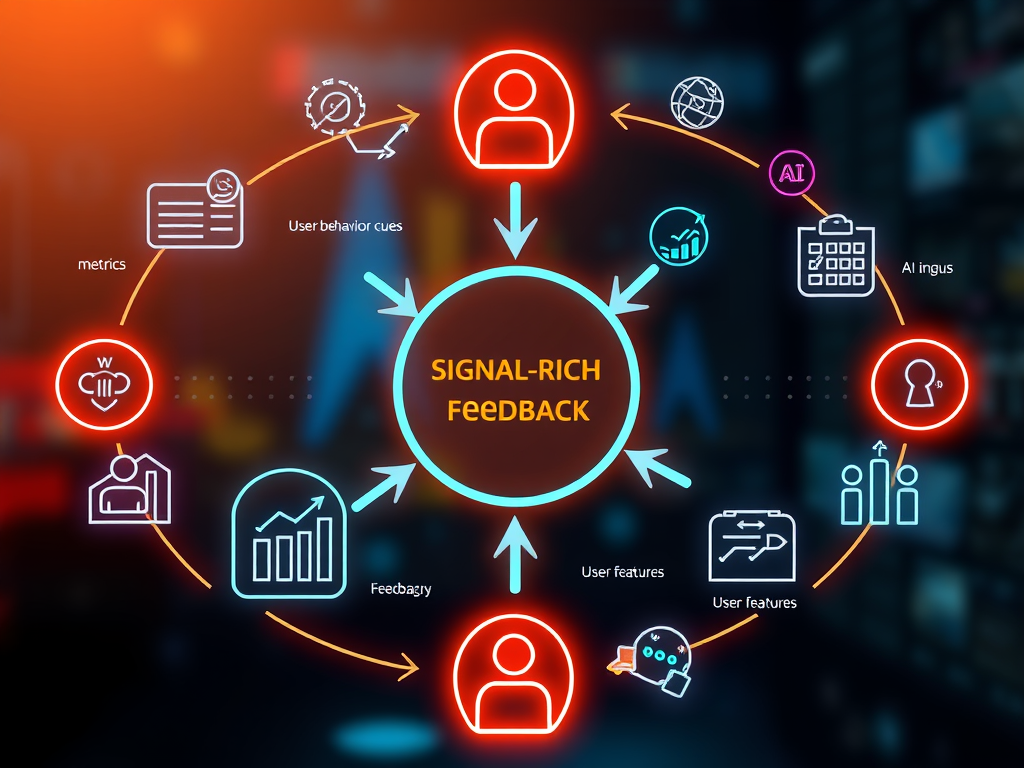
How to architect products that continuously learn and evolve.
When Feedback Becomes Fuel
You launch a feature.
The metrics roll in.
Some users click, some bounce, a few complain.
Then… silence.
You move to the next sprint — roadmap in hand, assumptions intact.
But what if the product could respond, reframe, and learn while it was live?
That’s not just good product thinking.
That’s a signal-rich feedback loop in action.
What Is a Signal-Rich Feedback Loop?
Most feedback loops in product teams look like this:
- Ship → wait → survey → interpret → react (next quarter)
But a signal-rich feedback loop flips that model:
It captures behavioral cues as they happen
Interprets signals continuously — not just post-release
And feeds insights back into the product in real time
It’s not just about what users say.
It’s about what their behavior reveals — and how fast your product responds.
Why This Matters More in the Age of AI
In a world where products are infused with AI, your job as a PM shifts.
You’re no longer just releasing features.
You’re engineering adaptive systems.
Without feedback loops:
- Your model might fail silently (e.g. hallucinate or bias out)
- Your product might lose trust before you notice
- Your insights get trapped in dashboards instead of action
AI doesn’t just need data to train — it needs data to grow.
That’s where signal-rich feedback loops become critical. They enable:
- Live learning – where usage patterns influence responses in near-real time
- Model fine-tuning – by flagging low-confidence, outlier, or failure cases
- Continuous relevance – when features evolve with how users behave, not how teams plan
And most importantly:
Signal loops move learning from humans → into the product.
That’s the AI-native difference.
The Anatomy of a Signal-Rich Loop
Designing such loops requires intentional thinking across three levels:
1. Signal Capture — “What are users telling us, even when they’re not saying anything?”
Look beyond surveys. Signals live in:
- Behavioral drop-offs (where did effort exceed expectation?)
- Repeated interactions (e.g. same prompt used 3x — unclear feedback)
- Silent usage (features with low interaction but high importance)
- Corrections or workarounds (e.g. editing AI output right after generation)
- Tool exits (did users leave mid-task? That’s a silent red flag)
2. Signal Interpretation — “What does that behavior really mean?”
This is where raw telemetry becomes insight.
Tactics:
- Clustering by behavior: Are some user cohorts reacting similarly?
- Correlating metadata: Do errors increase at certain times, devices, or roles?
- Synthesizing feedback at scale using AI tools (NLP, topic modeling)
- Tracking AI feedback: Confidence scores, override actions, human rejections
Caution:
Don’t jump to conclusions. Behavior ≠ intent. Pair analytics with contextual framing from support tickets, community posts, and interviews.
3. Loop Closure — “How does the system change as a result of what it learned?”
A loop that doesn’t feed back into your product isn’t a loop — it’s just data storage.
Real loop closure examples:
- In-product adjustments: e.g. hide unused features, change prompt defaults
- Model correction: flag samples for retraining or adjust retrieval rules
- UX friction fixes: if drop-offs increase on a mobile step, suggest alternatives
- Roadmap prioritization: turn insights into backlog-ready problem statements
- Retro loops: bring behavioral signals into sprint retros — make “user truth” part of process truth
Examples of Signal-Rich Feedback in Action
Here are 4 real-world patterns you can adapt:
1. Figma’s cursor chaos = collaboration clarity
When real-time cursors got overwhelming, Figma added smart filters.
Signal loop: high friction → user frustration → UX evolved mid-usage.
2. Otter.ai’s transcription edits = model retraining
User edits on transcriptions are logged as signal to improve the model.
Loop closed: AI improves by learning what users fix most often.
3. Grammarly’s “ignored suggestions” = UI calibration
When users routinely dismiss a suggestion, it’s downgraded or rephrased.
Loop impact: saves attention and improves trust.
4. Notion AI’s “undo + regenerate” = prompt rethinking
When users undo AI-written text and re-trigger with a new prompt, it flags ambiguity.
Signal use: to improve onboarding and surface prompt variants.
The thread across all examples:
Listening is embedded in the product — not just the team.
Building a Culture That Supports the Loop
The best loops don’t start with tools — they start with mindset.
To truly embed signal-rich feedback, your team needs more than analytics.
It needs a culture of curiosity, accountability, and adaptive learning.
🧠 Here’s how to nurture that culture:
- Think in loops, not launches
Treat every feature as the start of a conversation — not the end of delivery.
- Make signal visibility easy
Dashboards shouldn’t just exist. They should be understood, discussed, and acted upon in regular rituals. - Frame questions in terms of learning
In sprint reviews, retros, and roadmap discussions, ask – “What did we learn about the user we didn’t know before?” - Design with instrumentation in mind
Build metrics into the UX from Day 1. Don’t let tracking be an afterthought.
If you can’t measure the outcome, you can’t close the loop. - Let the product carry part of the learning
Your AI features should evolve with use, not just with time.
That’s where adaptive UX, prompt testing, and model tuning become living parts of the system.
Products don’t learn by accident.
They learn by design — when teams are committed to listening.
Final Thought: Products That Learn Win
Products are no longer static.
The ones that win don’t just ship well — they listen well.
Signal-rich loops turn your product from a launchpad into a learning system.
And in the age of AI, learning is your moat.
So ask yourself:
- And how often does our product listen back?
- What signals are we listening for?
- What signals are we ignoring?
Thanks for reading 🙏
Stay Curious! Stay signal-led!
Build systems that listen — and evolve with purpose.
“This post is part of the AI for PMs Series — a curated journey into signal-led thinking, strategy, and AI’s role in modern product management. Explore all posts here”
Leave a Reply