
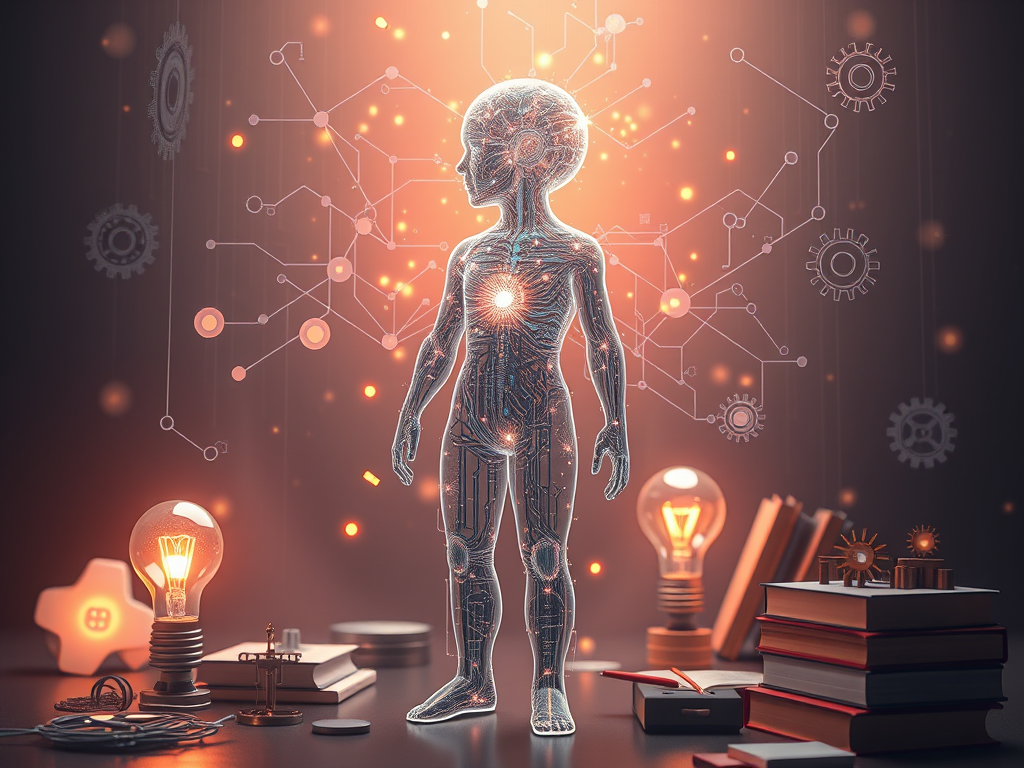
You ask a machine to solve a problem. It doesn’t just answer — it reasons, adapts, and improves.
Now ask yourself: what does that make us?
Are We Ready for Intelligence Without Instruction?
You tell it a goal.
It figures out how to get there.
It adapts.
It improves.
It does it again — without being told.
That’s not just automation. That’s not just AI.
That’s Artificial General Intelligence (AGI) — and it could be the most profound technological shift of our lifetime.
Yet most conversations about AGI are either alarmist or ambiguous.
This article aims to do something different:
- Clarify what AGI actually is
- Dispel what it isn’t
- And explore why it may redefine how we think, learn, and act — as individuals and as a species
What AGI Is (and Why It’s Different from AI)
Most of what we call AI today — even the smartest tools we use — is narrow AI:
- It can write poems, summarize documents, or beat you at chess.
- But only because it was trained to do exactly that.
AGI is something else entirely.
It doesn’t just perform. It reasons.
AGI = the ability to understand, learn, and apply intelligence across domains.
It can:
- Solve unfamiliar problems
- Transfer knowledge from one domain to another
- Set and pursue its own goals (with constraints)
- Improve itself continuously
If current AI is like a toolkit, AGI is like a thinking being — without a body.
Imagine:
- A system that learns like a human child — from experience, not just data.
- That can write code, understand sarcasm, play chess, clean a room — and explain why it did any of those.
- That can apply reasoning, solve problems, and improve its own architecture.
It’s not just automation. It’s cognition.
What AGI Isn’t (Yet)
There’s a lot of noise — so let’s ground the expectations.
AGI is not:
- An all-knowing oracle
- A sentient consciousness
- A self-aware entity
- Guaranteed doom or utopia
It’s not “the singularity.”
It’s not Skynet.
It’s not going to wake up one day and “decide” to replace us.
AGI is not magic. It’s just math — applied in a way we’ve never experienced before.
But that’s exactly what makes it powerful… and unpredictable.
Why AGI May Redefine Human Thinking
Let’s pause here. Because the most profound change AGI brings might not be technological.
It might be philosophical.
Here’s why:
1. We’ve Always Measured Ourselves by Intelligence
“I think, therefore I am.”
We value memory, logic, cleverness, articulation.
But AGI will match — and likely exceed — us on all those fronts.
So then what?
Do we redefine value as something else?
Empathy? Creativity? Purpose?
Or do we double down on being “machine-compatible”?
It forces us to ask:
- What is uniquely human if not intelligence?
- Is there a difference between computation and comprehension?
2. We’re Already Adapting Our Minds for the Machine
Just observe:
- People now write in “prompt-ready” formats
- We craft our thoughts to be digestible by algorithms
- We’re learning “prompt engineering” like it’s a core skill
We are reformatting ourselves — not because machines asked us to, but because it feels more efficient.
That shift is subtle. And irreversible.
3. Cognitive Outsourcing Is the New Normal
Remembering birthdays? Thinking through dilemmas?
We’re outsourcing them to:
- Reminders
- Chatbots
- Social cues
- Recommenders
AGI would accelerate this. And it begs a question:
What parts of our thinking do we still own?
If we stop practicing logic, do we lose it?
If we stop struggling with questions, do we lose wisdom?
4. We May Confuse Simulation With Understanding
A well-trained AGI can explain quantum physics in haiku.
But does it understand quantum physics?
No. It simulates understanding.
It knows the right moves — but not why they matter.
The danger?
Humans may forget the difference between true insight and high-quality imitation.
And in a world optimized for convenience, imitation often wins.
Why This Matters for Product Leaders, Designers, and Thinkers
AGI isn’t just coming for coders or creators.
It’s coming for problem-solving itself.
That means:
- Discovery will change — AGI can test concepts at scale, instantly.
- Strategy will change — AGI can simulate outcomes across markets.
- UX will change — AGI interfaces may anticipate intent before it’s expressed.
- Ethics will change — because outcomes won’t always be human-led.
It will:
- Predict outcomes
- Explore infinite paths
- Reduce the cost of experimentation to nearly zero
But this raises a new challenge:
When everything becomes possible — how do we choose what’s meaningful?
The new skillset won’t be just technical.
It will be:
- Ethical
- Strategic
- Intentional
When the machine thinks with you, not for you — you need to know where your thinking ends, and its begins.
Final Thought: The Leap We Didn’t Expect
AGI may or may not arrive soon.
But the bigger shift is already happening:
- We’re outsourcing judgment.
- We’re delegating decisions.
- We’re integrating intelligence we didn’t earn.
And that should make us pause — not out of fear, but curiosity.
Because if AGI helps us think better, we win.
But if it thinks for us before we understand ourselves — we lose something we may never get back.
The next leap isn’t AGI becoming more human.
It’s humans deciding what kind of intelligence they truly want to keep.
And that’s the leap we must not take blindly.
Further Exploration
- The Alignment Problem by Brian Christian
- When AI Outgrows Human Control (Wait But Why)
- AGI: A Gentle Introduction (LessWrong)
- Artificial General Intelligence: Wikipedi
Thanks for reading 🙏
Stay human! Stay intentional!
Explore all articles at www.thepmpathfinder.com
Leave a Reply